Course Details
Certificate in Arts Integrated Wellbeing Facilitation
26 Weeks
Registrations Closed
About the Certification:
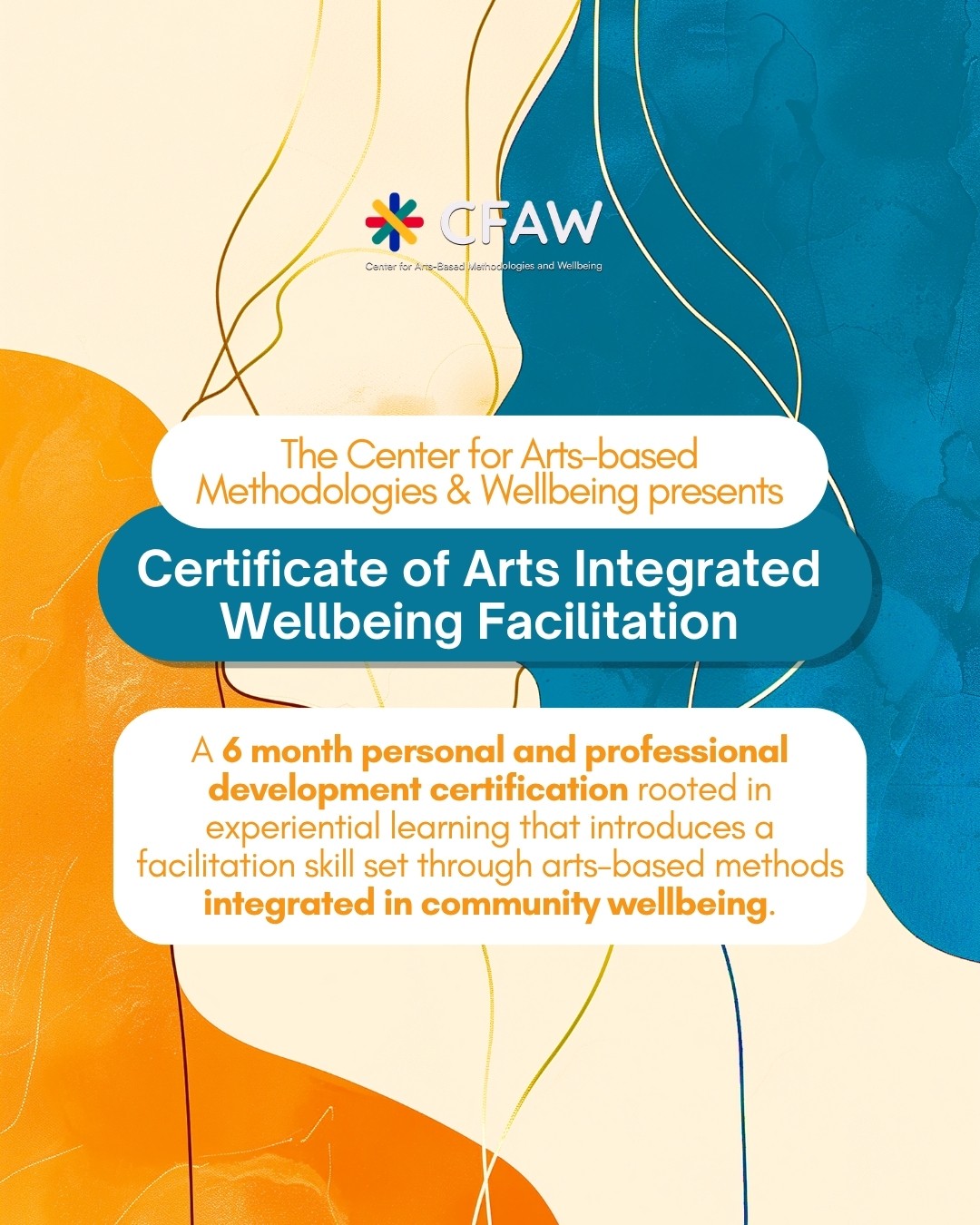
The Certificate in Arts integrated Wellbeing Facilitation is an intensive 6 month long personal and professional development certification to develop foundational skills to facilitate wellbeing sessions integrated with arts-based methods. CFAW is a well known center for arts-based methodologies and participatory approaches. In prime human centered participatory approaches our facilitation for this initiative is led by Organizational Head, Rutaba Syed and Art Therapy Lead, Abeer Ahmed.
This certification is an experiential training that helps in understanding and facilitating skills and concepts that allow participants to hold space for themselves and for others, especially in group settings. Through this certification students will enhance their self-awareness through active reflection in their professional endeavors and their personal lives. Students will build their facilitator personas and personalized art approaches in practice, through in-person educational classes, modeled space holding, reflective assignments, assigned course material and observation transitioning to co-leading experiences through in-house facilitation of courses offered at CFAW.
This certification is a deep insight into how arts-based methods can be integrated with wellbeing discussions to further enhance space-holding for groups or individual existing practice with clients.
Psychology experience or prior professional experience is not a prerequisite. Anyone wanting to work with wellbeing, art and community is encouraged to apply.
Structure:
The certificate is a 6-month long commitment which spans over 5 key modules to build up to a CFAW certified facilitator.
The modules are as follow:
1. Foundations of Space Holding (May)
This module covers the basics of space holding and facilitation as a community facilitator. Students go deep into the various psychological approaches, guidelines of wellbeing workshops and methodology of arts as part of wellbeing facilitation.
2. Trauma Informed Facilitation (June)
This module covers the most crucial aspect of holding space for wellbeing audiences where we dive into trauma-informed concepts, build personal resilience of active processing as a facilitator and learn the art of holding tension that comes with social triggers.
3. Identity as a Facilitator (August)
Building personal identity as a facilitator, allocated time for self-preservation, skills to cope with compassion fatigue and compartmentalize personal and professional identities.
4. Experiential Learning (Continuous)
Hands-on experience in existing wellbeing workshops where students will start from observing/shadowing to co-leading wellbeing groups.
5. Workshop Facilitation Rounds and Submissions (September)
To complete the certification, students will be required to facilitate workshops that they personally design. These workshops will be supervised and assessed as part of their submissions.
A final essay paper and presentation on their overall journey of building their identity as a facilitator and space holding will be scheduled as part of certification completion criteria. Please note that this will be a reflective process and will be assessed based on your understanding of concepts in practice and personal implementation.
Shorter reflection submissions, both written and arts-based will be assigned throughout the course.
Course Theory:
The certificate provides students the opportunity to develop their understanding of wellbeing in a community setting and incorporate the application of Person-Centered and Trauma Informed Approaches, Gestalt, Adlerian-Indivisible Self through arts-based approaches. These theories will be implemented in a practical format through the experiential learning module.
Students will gain:
1. Trauma informed learning and facilitation skills
2. Reflective and Regulatory skills for self and others
3 Arts-based space holding training
4 On- site community experience
5. A selection of different age groups to work with
6. An opportunity to design and co-create with Lead Trainers
7. Skills to process triggering concepts for the self and hold space for it
Supervision and Reflection:
After the first module, students will have classes spaced out to allow them to work on their reflection submissions and maintain experiential learning. Supervision hours will be introduced in group/individual settings to maintain reflection and processing of material and experiential learning.
Assessment Submissions:
1. A Daily Drawing Journal will be expected for students to maintain to practice reflection through art. Don’t be alarmed! Its okay you dont need to have any prior art experience for this.
2. Weekly reflections will be submitted. To stay connected with self and the course.
3. 2 Papers, each 1500 words max will be submitted throughout the course.
4. One final Paper (2000 words max) and Presentation of the paper will be submitted and presented as a showcase of their 6-month journey. This will be done through participant consent, you don't have to showcase necessarily.
5. Facilitation Rounds through Independent workshops will be assessed.
You will be briefed for all of these details thoroughly while on-boarding. Take it easy!
Requirements to Apply:
No pre-requisites are a must since CFAW believes that a deep passion to work with the community is enough to apply. However, the application form and interview will be assessed in depth to grant acceptance.
Deadline to Register is 27th April, 2026.